 日本語
 English
 नेपाली
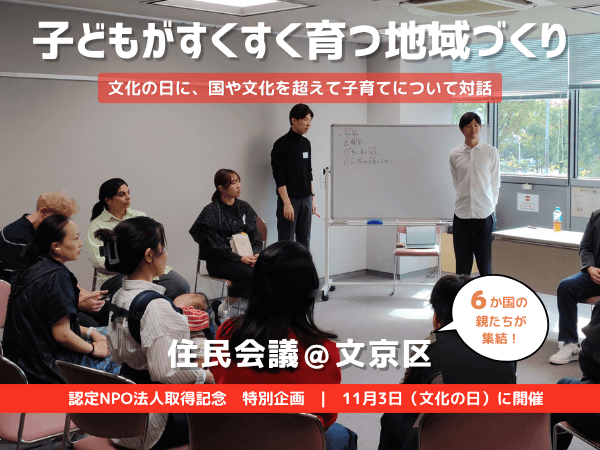
On Culture Day, we held a residents' meeting titled “Building a Community Where Children Can Thrive.”
This gathering brought together people from different cultural backgrounds and with different experiences to share their thoughts and experiences on the theme of raising children in Japan.
In addition to the one-on-one relationships we have been building through OFP, we felt a need for “social dialogue,” in which residents in similar situations can speak openly with one another across national and cultural differences.
This residents' meeting was the first step toward making that a reality.
A total of 11 parents from Japan and five other countries gathered.
With two facilitators guiding the discussion, the event began with participants introducing each other* in small groups.
They then spent about two hours exchanging candid views on two questions: “What kind of person do you hope your child will become?” and “What are the good things and challenges about raising children in Japan?”
* Introducing each other: A form of introduction in which group members ask each other questions and then introduce the person they interviewed.
Hopes for Their Children's Growth and Raising Children in Japan
The first question was: “What kind of person do you hope your child will become?”
“I want my child to find their own sense of purpose.” “I want them to develop their imagination.” “I want to give them more options for the future.” “I want them to have a variety of experiences and develop a global outlook.” “I want to provide them with a supportive environment.”
Regardless of nationality or culture, there were shared hopes that everyone could relate to as parents.
The conversation expanded to include the children's daily lives, studies, and sports, as well as the education the parents themselves had received in their home countries and the state of education in different countries. This gave participants an opportunity to explore how views on education vary depending on the environments and cultures in which people grew up.
The next topic, “Raising Children in Japan: What Works and What’s Challenging,” covered both the positive aspects of parenting and education in Japan and the questions and challenges parents encounter in everyday life. A lively discussion ensued about the balance between “rules” and “freedom” in society and schools, as well as between “academic study” and “learning beyond academics.”
[What Works Well]
Participants cited the safe environment, the respect that preschools and schools show for children's opinions and ideas, and the many opportunities for children to have a variety of experiences, such as daycare events, school trips, and choir competitions.
Repeatedly preparing and practicing for events, developing self-management skills and making memories with friends through overnight activities, and having opportunities to perform onstage in rented halls: These experiences are often taken for granted in Japan, but parents from various countries cited them as strengths of Japanese education, saying they help children grow and gain a sense of accomplishment.
[Challenges]
On the other hand, participants also shared candid opinions about the lack of opportunities for children to express their own ideas, the requirement for everyone to have the same school supplies, the burden on parents associated with extracurricular clubs, the lack of time to explore their interests and aspirations due to an excessive focus on advancing to the next level of education, the demands of maintaining relationships with other parents, and the emphasis on conforming to others.
Looking at everyday customs and systems through the perspectives of people with different cultures and experiences raised new questions.
It was striking to see participants listen attentively to one another's experiences and perspectives in a warm and friendly atmosphere throughout.
Insights Gained from Different Perspectives
During the final reflection, participants shared their thoughts and new insights from the dialogue.
◆ From Japanese participants
“It gave me an opportunity to reconsider things I had taken for granted from a different perspective.”
“I learned about the experiences and honest feelings of foreign residents and their children, and I want to share them with my own children.”
◆ From foreign participants
“I was happy to meet others who are doing their best to raise children in a foreign country.”
“I remembered how I felt when I first came to Japan and wanted to help families raising children.”
Our hopes are the same. But the perspectives shaped by our experiences differ in subtle ways.
Even when people have different nationalities and cultural backgrounds, they share many of the same hopes for their children and feelings about raising them.
At the same time, people have different perspectives shaped by their individual experiences.
A major outcome of this dialogue was that participants shared both their feelings and perspectives, deepening their understanding of one another.
Community “Connections” and “Mutual Support” Born from Dialogue
When people from different cultures and backgrounds share their thoughts and experiences around a common theme, they not only deepen mutual understanding but also create opportunities for new connections and mutual support.
“It was a very meaningful experience. Learning about cultural differences gave me a chance to experience moments of deeper understanding.”
“It was interesting to explore Japan in greater depth and learn how it is viewed from abroad.”
These are comments from participants.
During this exchange, participants gained new insights that went beyond learning about one another's experiences. Some reflected on their own parenting and daily lives, while others felt inspired to support someone else in the future.
This residents' meeting was a first for JII, held with the cooperation of a coordinator from the Japan Initiative.
Going forward, we plan to expand this initiative as a forum for addressing local challenges and building a better community.
JII hopes to continue creating opportunities for people in the community to get to know one another across nationalities and cultural backgrounds, and to foster connections through which they can support one another.
To everyone who participated and helped make this event possible, we are truly grateful to have shared this precious time with you. Thank you so much!