 日本語
日本語 English
 नेपाली
For Those Who Want to Become Otonari-san (Japanese Volunteers)
Currently, nearly 4 million foreigners live in Japan.How will Japanese society coexist with its new residents? This is a new challenge that we face in this era.
Foreign residents understand the culture and lifestyle of Japanese society, integrating into the community, while society deepens its understanding of the new residents.
Embrace and enjoy the culture as a part of it.
We dream of a society that embraces diversity, including foreign residents like these.
We launched the Otonari-san Family Friend Program (OFP).
Otonari-san Family Friend Program (OFP)
System
The Otonari-san Family Friend Program (OFP) pairs foreign residents living in the community with Japanese volunteers (Otonari-san) for a six-month period. This one-on-one exchange provides communication support to help participants practice Japanese, acclimate to Japanese life and culture, and integrate more easily into the community.
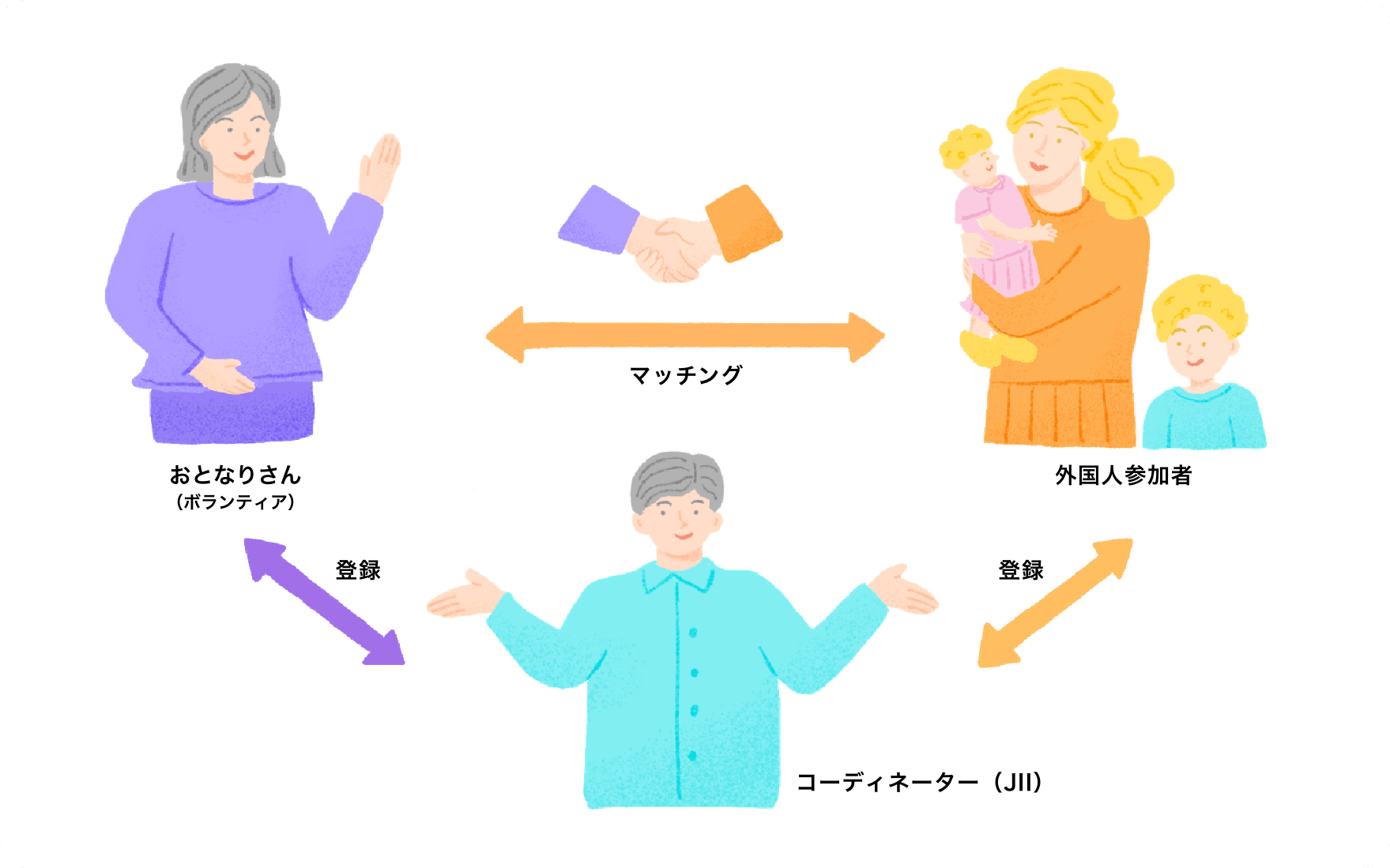

Engage in direct activities for 6 months (Volunteer ⇔ Foreign participant)
- Activities can be done from about 2 hours a week
- Conveying information about daily life and Japan
- Go out together to community activities and events
- Converse in Japanese
- A friendship-like relationship

Support for Volunteers (JII)
- Regular follow-up
- Consultation about support
- Information Provision
- Interaction Among Volunteers
- Trouble Response

Support for Participants (JII)
- Provision of Living Information
- Consultation Desk
- Expert Consultation
- Exchange Events

Expert Team
Lawyers, administrative scriveners, doctors, tax accountants, labor and social security attorneys, teachers, nurses, and others
Volunteer Activities
[Interact and Support Foreign Residents]
・Secure about 2 hours per week for interaction (including messages, face-to-face, etc.)
・Providing information about Japan's customs, culture, and society
・Assist with learning Japanese and serve as a conversation partner
・Providing information about local life and events
・Enjoy spending time together
・Be supportive as a friend and provide emotional support, among other things
Brush Up
・Share activity status once a month during pair activities
・Actively participate in study sessions and networking events
Participation Requirements
・Living in Japan (Tokyo 23 wards + surrounding areas)
・18 years old or older (adult)
・I want to support, engage with, and interact with foreign residents.
・I want to build trust with foreign residents and become a good neighbor and friend.
・Abide by the Activity Rules and do not engage in actions that go against the purpose of the program
(Engaging in activities that violate the law, commercial, religious or political solicitation, dating, marriage hunting, sexual relationships, or causing disadvantage, inequality, or physical and mental burdens to others.)
How to Participate
We carefully conduct pairing-up based on various factors to facilitate building good and lasting relationships.
90% of participants* wish to continue their interactions as friends even after the activities have ended.
*Based on the survey responses after the activity

1. Application
- You will receive an invitation to the information session *Attendance at the information session is mandatory / Free of charge
2. Information Session & Hearing
- After the information session, if you wish to participate as a volunteer, please register (Registration fee 1,000 yen/person)
- After registration, you can participate in activities for OFP members.
3. Pairing-up
- Introduce pair candidates based on registration details
- After the interview, if both parties agree, the pair is formed
- After the pair is established, pay the OFP membership fee (OFP membership fee 3,000 yen/person)
4. Activities
- Activities as a pair for 6 months
- Support from coordinators during the period
- Expert support available as needed
For those who wish to volunteer as Japanese volunteersClick here
Participation Fee (Registration Fee and OFP Membership Fee)
● Registration Fee (One-time at registration): 1,000 yen/person
・You will pay at the time of registration after understanding the activities.
・After registration, you can participate in activities for OFP members. (Examples: various exchange meetings, refugee support, operation supporters, etc.)
● OFP Membership Fee (Upon Pair Formation): 3,000 yen / person
・A pair is formed when both parties agree, and the OFP membership fee is paid.
・During the pair activity period (6 months), support from coordinators and experts is available.
・Please share your activity status once a month in the form of a questionnaire.
・Payment methods: Credit card, bank transfer, etc.
* Pair formation cannot be guaranteed as it varies depending on individual conditions.
Why are registration and membership fees necessary?
There is a Participation Fee Reduction System
A reduction and exemption system can be applied for those with special circumstances.
Examples of Application
– Refugees and Displaced Persons: Exemption from registration and participation fees
– Due to circumstances such as disabilities, illnesses, single-parent households, low-income households, and unstable employment, there is a significant financial burden: registration fees are waived, and membership fees are half off.
– Students with significant tuition burdens, such as those using scholarships: Registration fees and membership dues are half price
–Other reasonable accommodations needed: Individual consultation
Frequently Asked Questions
Many volunteers who interact with foreign residents as Otonari-san volunteers report that they have broadened their perspectives by encountering cultures and values different from those in Japan. Additionally, learning about the anxieties and difficulties faced by foreigners living in Japan provides an opportunity to consider things from their point of view. Through everyday interactions, volunteers can enjoy new discoveries and encounters while learning the importance of cross-cultural understanding and communication.
Registered members can participate not only in OFP but also in various activities such as member networking events, club activities, Japanese language learning support, refugee assistance, and operational support roles.
OFP is not simply about introducing foreign residents; rather, we carefully conduct pairing-up based on various factors such as the needs and conditions of both parties, aiming to build trust as much as possible and deepen continuous communication. We only introduce matches when conditions align, so please understand that we cannot guarantee the timing of pairing-up or the introduction itself. The actual waiting period varies from a few days to several months.
During the hearing, we will discuss your language skills, expectations, participation requirements, and preferences in detail. We will introduce candidates based on each individual's specific situation. We do not assign candidates randomly.
Operating OFP activities involves significant costs for management and administration, including a system that strictly manages personal information, briefing sessions, pairing-up, and follow-ups. Currently, activity funding mainly relies on one-time private grants and donations, and we are not yet in a position to secure stable funding. To continue OFP activities, the support of all participants is indispensable. At present, about 13% of the activity costs are supported by registration and membership fees from participants.
As a guideline, if you can allocate about 2-3 hours a week, including chat and video calls, you can engage in activities. Additionally, if you can arrange to meet in person every 2-3 weeks, it will be easier to build trust. If you feel any difficulties regarding the frequency, timing, or duration of communication, it's possible to discuss and adjust with your partner.
Currently, foreign residents from over 40 countries and regions are participating. The largest group, about 40%, consists of foreign families raising children, followed by working adults and students (including those in Japanese language schools and universities/graduate schools), among others.
It is okay even if you cannot speak a foreign language. Pairing-up is done considering the language situation of both parties. Also, since many foreign participants want to speak in Japanese, sometimes the interaction will be only in Japanese.
It's okay. As long as you have respect for others and a desire to build good relationships, you can participate. We offer many opportunities to learn, such as training sessions for volunteers and social gatherings among volunteers. During activities, coordinators are always available to support you, so you can consult with them anytime if you have any problems or questions.
The method of interaction will be decided through consultation between the two paired participants. Therefore, the forms of interaction vary. To facilitate building trust, we generally recommend face-to-face meetings; however, depending on mutual convenience, a combination of online and in-person interactions is also possible.
During the six months of pair activities, a dedicated coordinator provides ongoing support. By filling out a monthly activity status survey, the coordinator can monitor progress and step in to assist when needed. This support system helps prevent potential issues before they arise. While there may be cancellations or changes in pairs due to health problems, moving, or mismatched activity frequency, there have been no conflicts between participants so far, ensuring everyone can participate safely and with peace of mind.
Participant Testimonials
-
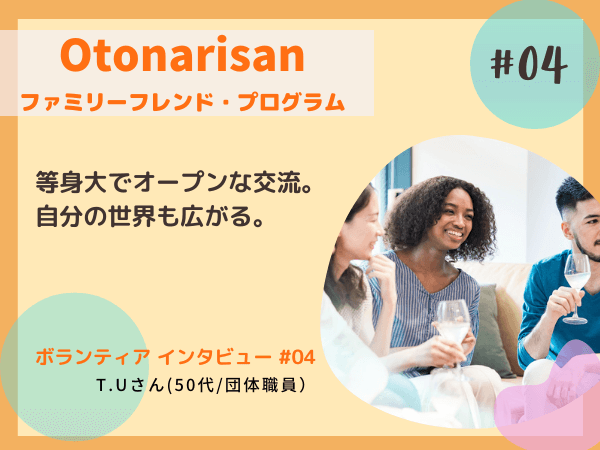
Genuine and open interaction. Expanding my own world (OFP Volunteer Experience)
-
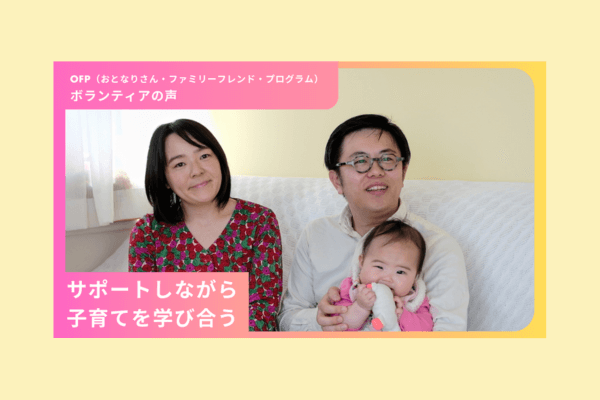
International Exchange with Family While Living in Japan (OFP Volunteer Experience)
-

Supporting each other as friends who can share worries while enjoying fun interactions (OFP volunteer…
-

Serving homemade dishes to each other and nurturing friendship as entire families (OFP Volunteer Experience)
-

They repeatedly expressed their gratitude for the encounter, which made me truly happy (OFP volunteer…
-
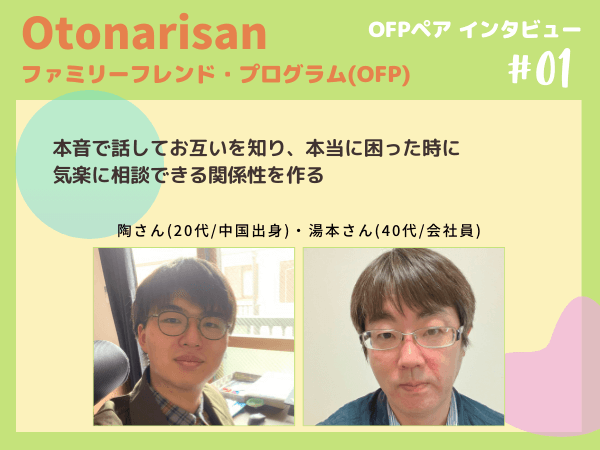
Speak honestly to get to know each other and build a relationship where you can comfortably consult each other when truly in trouble (OFP experience…
-

I improved my Japanese and was also able to enjoy intercultural exchange! (OFP testimonial)
-

We became wonderful friends who keep in touch even after the program ended! A perfect pairing-up!…
-

Thanks to Otonari-san, I gained the courage to speak to Japanese people (OFP testimonial)