 日本語
日本語 English
 नेपाली
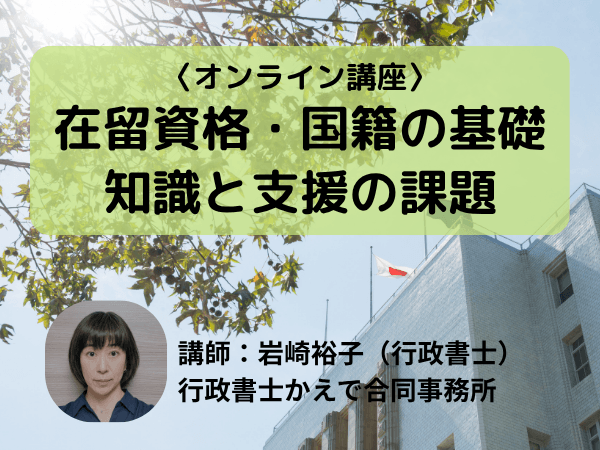
The most important "residence status" for foreign residents living in Japan.
We held an online study session on this important theme!
Japan's residence status system is very complex, but immigration-related topics have gained increased interest from the general public in recent years due to revisions to the Immigration Control Act and other factors.
Despite being a weekday, more than 30 people participated.
This time, we invited Ms. Yuko Iwasaki, an administrative scrivener, as the lecturer.
Ms. Iwasaki mainly handles procedures related to residence status, naturalization and nationality, birth, and family matters.
She has been involved in supporting foreigners living in Japan for over 20 years.
In the study session, topics ranged from basic knowledge to changes in policies and systems, as well as the diversification of consultation topics due to recent changes in marital and parent-child relationships,
We heard from a perspective unique to someone actively working on the front lines.
How the residence status directly affects the lives of foreigners
From those that allow employment to those that do not, there are reportedly as many as "29 types" of residence statuses 😲
And as immigration policies change fluidly, the content and systems of residence statuses are also changing from time to time.
Although they have entered Japan, the reality is that maintaining their status of residence is difficult.
We heard about the reality that the recent tightening of immigartion policies is directly impacting their lives.
"Without a proper understanding of your residence status, your daily life can be greatly affected "
Most foreign residents enter Japan without fully preparing for the life in Japan and have not realized the difficulties they may face in the future.
Also, in cases where unexpected events such as illness, accidents, or job dismissal occur,
people lose their residence status and suddenly lose their social safety net for living are not uncommon.
In addition to suffering significant damage in their lives, there is also the possibility of losing the very foundation of their livelihood.
We have come to recognize once again the unstable situation that foreign residents are placed in.
Diversification of Consultation Topics
Additionally, with the increase in international couples and same-sex marriages, the nature of consultations has also diversified in line with recent changes in marital and parent-child relationships.
One of the most memorable points was that "a baby's residence status is linked to that of the parents."
It is said that with the increase in the young workforce holding residence statuses such as Specified Skilled Worker in the future, the number of children with foreign nationality is also on the rise.
Depending on the type of residence status the parent holds, it greatly affects where the child can study and live in the future.
She said that therefore it is important to thoroughly plan ahead the situation before the child is born.
As mentioned above, due to the increasing complexity of systems and real life circumstances, there has been a rise in very complex consultations involving intertwined medical care, welfare, and legal affairs in recent years,
It was said that it is necessary to support foreign residents through collaboration across a wide range of fields, rather than relying on just one administrative scrivener.
What is important is to "always understand your own situation and have someone to consult with when needed."
It is important for foreign residents to "have accurate understanding of their residence status, their own situation, and have someone you can turn to for advice."
We in Japan should encourage them to have that kind of awareness.
And to prevent them from becoming isolated, it is important to create supportive community connections like those of Otonari-san.
- It was a very informative and thought-provoking study session.
"I had only known bits and pieces from the news, but I was able to learn about the challenges faced on the ground due to recent policy changes."
Furthermore, I learned that changes in circumstances such as illness or accidents can affect the residence status of foreign residents, making their position unstable.
Also, following the changes in residence status, foreign residents are easily affected by politics, social conditions, and other factors,
I was once again reminded that they are socially vulnerable individuals."
"It was an opportunity to think about what I would do if I were actually in that situation..."
"I have once again realized the difficulties foreigners face living in Japan. My motivation to support them has grown even stronger."
Feedback from participants 💡
"So that everyone can live safely in Japan regardless of nationality," even in an increasingly complex environment, we stand by each foreign resident individually,
It was also a time when we were deeply impressed by Ms. Iwasaki's dedication.
We at JII also want to ensure that the foreign residents can live in Japan with peace of mind.
We hope to continue supporting each individual’s life and well-being moving forward.