 日本語
日本語 English
 नेपाली
2018 United Nations Counter Report:
School Refusal in Japan
Ryouko Uchida
1. Current Situation Regarding School Refusal
In Japan,since 1991, students in compulsory education, both elementary and junior high school, who are absent from school for a continuous or intermittent total of30 days or more in a year are referred to as "school refusal" (excluding absences due to illness or financial reasons). Prior to that (1966–1990), absences of50 days or more were classified as "school aversion" and described as "refusal to attend school." It was believed that school refusal (non-attendance) was often linked to the student's personality traits, as well as parenting attitudes, parental characteristics, and family relationships.
The Ministry of Education and the Ministry of Education, Culture, Sports, Science and Technologysince 1966have collected statistics on school refusal and non-attendance, primarily targeting children and parents for treatment and education, implementing measures against school refusal. As shown in Chart 1, the number of children refusing to attend school was4,430elementary school students and12,286middle school students in1966. By2016, this number increased to31,151elementary school students and103,247middle school students, and this upward trend has continued since1980. In response, the Ministry established the "School Adaptation Measures Research Cooperation Conference" and, based on its recommendations, acknowledged that "school refusal can happen to any child. Issues in school life such as bullying, academic difficulties, and distrust towards teachers can lead to school refusal," thus revising their understanding.
Subsequently, the Ministry of Education took measures for early detection and early return to school for students who are not attending school, based on the recommendations from the "School Non-Attendance Countermeasure Research Cooperation Conference." Specific measures included creating a "safe space" in schools and introducing school counselors. However, since 1990, despite the acceleration of declining birth rates, the number of students not attending school has continued to rise. Contributing factors include bullying, harsh disciplinary measures such as corporal punishment by teachers, and the feudal-like relationships between seniors and juniors in club activities. Children felt the need to distance themselves from schools, which can be seen as the scene of their suffering (by being absent, for example). However, without understanding the reality of the situation and without taking measures, the idea of children missing school was not accepted. Implementing measures to return children to school early without addressing the root causes of non-attendance has contributed to the increase.
Children are pressured not to miss school, and educational authorities are scrambling to reduce the statistical number of children who are absent, further intensifying the pressure on them.

2. The Reality of School Refusal in Japan
The Ministry of Education, Culture, Sports, Science and Technology's commissioned research on "The Actual Conditions of School Refusal" has conducted follow-up surveys five years later for junior high school third-year students who experienced school refusal, twice in the past (2001 and 2014). Additionally, the ministry conducts the "Basic School Survey" and the "Survey on Issues Related to Student Behavior and Guidance" every year. What emerges from these two surveys is a significant gap in perception between students who are school refusers and school staff.
2014The responses from students in the 2014 "Survey on School Refusal" and the school reports from the same year's "Survey on Problem Behaviors of Children and Students" are as follows.
1st.Friendship issues including bullying - Students52.9% (School Report16.5%), 2nd.Difficulty understanding studies - Students31.2% (School Report9.3%), 3rd.Relationship with teachers - Students26.2% (School Report1.6%), 4th.Club activities - Students22.8% (School Report2.2%), 5th.Admissions, transfers - Students17.0% (School Report2.9%), 6th.Issues with school rules - Students10.0% (School Report1.8%).
It is noteworthy that among the children who reported being absent from school,26.2% indicated this, while school reports show1.6%. Where does this discrepancy come from? The annual report by the Ministry of Education, Culture, Sports, Science and Technology on "Problematic Behaviors of Students" highlights emotional turmoil such as anxiety28.1%, and lethargy26.7%, which are among the top concerns. In many cases, children attend school under pressure from parents and teachers, feeling a "duty to attend" and fearing it will negatively impact their future education and career paths, leading to physical and emotional exhaustion before they eventually stop attending. Therefore, by the time they begin to take breaks, they are already in a state of lethargy and emotional confusion. This fatigue, which accumulates before they stop attending school, is the real cause, and attributing their absence solely to this state is a misunderstanding.
The Ministry of Education, Culture, Sports, Science and Technology's measures for school refusal are based on reports from schools, which means they are far from solving the issue of school refusal. At the very least, these efforts do not address or improve the reasons why children are unable to attend school. In fact, the more early return-to-school strategies are implemented, the more the number of children refusing to attend school continues to rise.
3. Issue 1: Medical Intervention for School Refusal and the Risky Medication Problem
Children who have been hurt by bullying, corporal punishment from teachers, or punitive guidance in clubs often lose their sense of belonging at school, leading to physical and emotional distress, reluctance to attend school, and sporadic attendance. As schools shift towards early reintegration strategies, they pressure parents to "work together with the school to encourage their children to attend." This may involve classmates, homeroom teachers, and school social workers making home visits, or community welfare commissioners and local educational support staff coming to pick them up for school.
Children who feel cornered often experience physical and mental health issues (such as stomach pain, fever, headaches, and more) and seek medical attention at pediatric clinics. However, they are frequently told that their conditions are not typical medical illnesses, leading to an increase in cases where teachers, school counselors, and health educators recommend that they visit psychiatric or psychosomatic clinics. As a result, more elementary and middle school students are being prescribed medications such as sleeping pills, anti-anxiety drugs, antidepressants, and antipsychotics, even at the stage of school refusal or sporadic attendance (see Chapter 23 "Developmental Disorders"). The Ministry of Education, Culture, Sports, Science and Technology's early school reintegration strategies continue to apply pressure for attendance while leaving the underlying issues unaddressed, resulting in an increase in the quantity and variety of medications prescribed to children who cannot take time off from school, leading to some suffering from side effects. Children who are emotionally unstable due to bullying or isolation from school pressure may resist their parents strongly and refuse to follow healthy routines, which can lead to misdiagnosis as developmental disorders.
Children who are hurt by relationships at school and feel they have no place there can find relief from their physical and mental symptoms when they escape to a safe space (home) to rest. However, there are few schools or parents who accept school refusal. Voices of children expressing their feelings can be heard from various places, saying things like, "If I had known there was school, I wish I had never been born," "If I have to go to school, I might as well have died in my mother's womb," "I want to drop out of school," and "What is the purpose of school?" Children are fundamentally questioning "who school is for" and are seeking a place where they can rest safely and comfortably.
4. Issue ② - Suicide Among Children Under 18 - Kids Who Can't Take a Break from School -
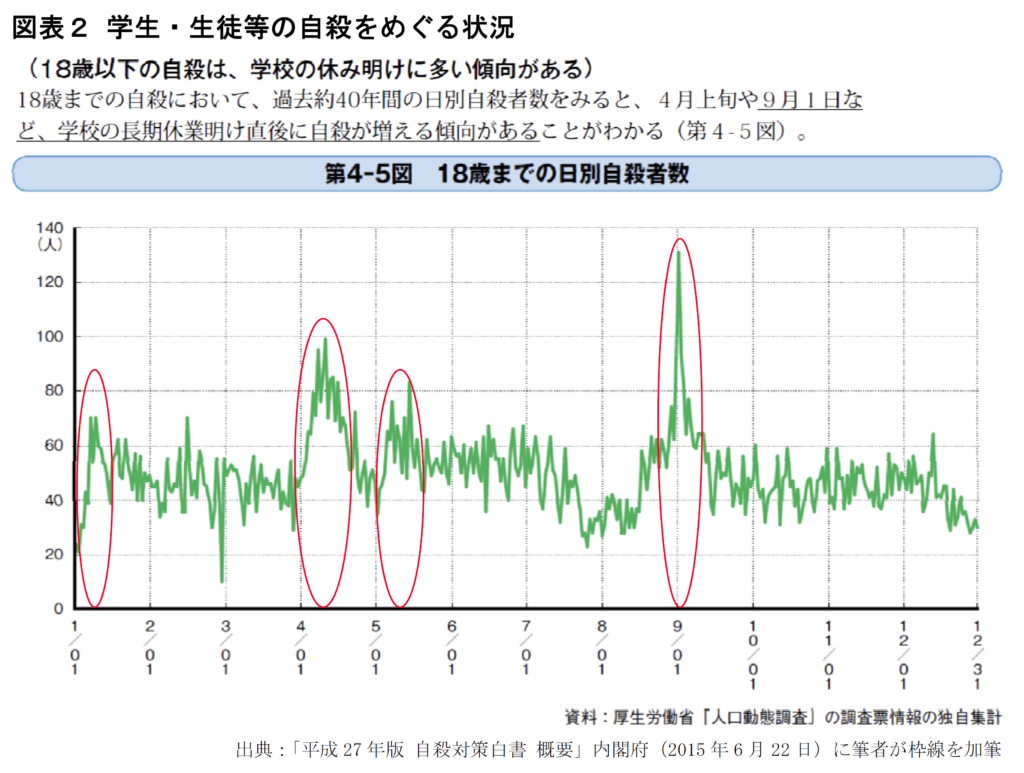
Among children who have been deeply hurt by bullying, corporal punishment, and damaging guidance from teachers, some believe that they cannot take a break from school because it is compulsory education. As a result, they may continue to attend school despite their struggles. There are children who, after enduring the pressure of forced attendance, reach their physical and mental limits and take their own lives. It is particularly concerning, as shown in Chart 2, that when looking at the daily suicide rates over the past 40 years, many children take their lives after long breaks (after summer vacation, winter vacation, spring break, and Golden Week). Conversely, suicides during long breaks are rare. Additionally, among children who are deeply affected by bullying, harsh teaching methods, and corporal punishment in the classroom, some may develop conditions such as being unable to write or read textbooks due to psychological trauma. The periods surrounding midterms and finals, which are stressful, also see a rise in the number of children taking their own lives, following the long breaks.
The total number of suicides in Japan has decreased due to national measures, but the rate of suicides among middle school students hasincreased since 2011. Many children have left notes expressing feelings like "I want to skip school" and "I would have lived longer if there was no bullying." School refusal has become a lifeline for some.
5. Issue ③ Establishment of the Educational Opportunity Assurance Act (Truancy Countermeasure Act)
The Ministry of Education, Culture, Sports, Science and Technology's early intervention measures for school refusal have nearly run their course, leading to a deadlock. During this time,2014, citizens and researchers managing places for children who refuse to attend school approached the bipartisan Free School Parliamentary League in the National Diet, initiating efforts to establish the "Free School Law." This aimed primarily to seek financial support for free schools attended by children who refuse to go to school.
However, there were voices of opposition from children who are not attending school, their parents, and citizens regarding the content of the legislator's bill, leading to several revisions. Ultimately, the bill known as the "Law on Securing Educational Opportunities Equivalent to Regular Education at the Stage of Compulsory Education," commonly referred to as the "School Non-Attendance Measures Law," was enacted in 2016 December. The law defines "children and students who do not attend school" separately from "children and students," framing non-attendance as an individual issue. Special schools for non-attending children were established, creating a pathway for children who are victims of bullying, harsh teacher discipline, corporal punishment, and other issues in school education to be separated from regular classes.
Furthermore, under the guise of providing continuous organizational support for children who are absent from school, a "Student Understanding and Educational Support Sheet" has been created. This sheet is generated when a student has been absent for seven consecutive days, and it allows all school personnel to share the child's personal information and family circumstances, which are then managed by educational support centers and similar organizations. Due to the belief that "children who have been absent from school once are at risk of recurrence," personal information is collected across different school types until high school graduation and is retained for an additional five years. This constitutes an infringement on the child's privacy and rights.
2016The bill was about to be enacted in Septemberby the Ministry of Education, Culture, Sports, Science and Technology, which clearly stated that "it is necessary to appropriately respond, such as taking measures to withhold promotion or graduation under the principal's responsibility," with a caveat.There are concerns that the rights of children who are absent from school may be compromised, as the existing privileges of promoting and graduating based on legitimate reasons for absence have been recognized through the efforts and movements of stakeholders, parents, and citizens.
Children have the right to learn at school, but they are not obligated to attend. It is essential to ask the child who has become a victim of school refusal, due to the violation of their right to learn, what their best interests are.
After the law was enacted, a notice was sent to the parents of children in Okinawa Prefecture who were not attending school, stating that if the absences continued, graduation certification would not be possible.
6. Challenges
Children need a safe and secure environment where they can learn and grow without fear. They seek a space for human-centered learning that allows them to break free from the stifling school life characterized by competition based on test scores and strict regulations. However, the Ministry of Education's measures for school refusal focus on early reintegration and reducing the number of absences, which prevents children from taking time off to avoid bullying and other physical and mental harm, as well as violations of their rights. It is essential to prioritize the establishment of an educational environment that guarantees children the right to take time off from school without conditions and to return freely afterward.
Therefore, there is an urgent need to abolish the school attendance support law (Educational Opportunity Assurance Law) that includes provisions for "special schools for non-attending students" and "student understanding support sheets."
Children are mistakenly taught that attending school is their duty, leading them to struggle with the inability to take a break from school. In a society like Japan, where there is a strong belief in the importance of school, many children lose sight of their future, the meaning of their existence, and the value of their lives, resulting in tragic outcomes. It is essential to inform all children about the United Nations "Convention on the Rights of the Child," particularly Article 31, which states the "right to rest and play." We must ensure that children can make their own decisions about taking time off from school during crises, dispel societal misunderstandings and prejudices regarding school refusal, and correct the unfair treatment of children who have experienced school refusal in terms of their educational and employment opportunities.
①Creating Association (Citizens’ and NGOs Association for the U.N. Convention on the Rights of the Child,
Japan) submitted to the UN Committee on the Rights of the Child in November an Alternative Report, The Childhood Impoverishment in Japan under the Neo-liberal and the Neo-conservative Momentum.
The organization will start distributing the English report from June (1 copy for 7,000 yen). To apply, please fax to: 03-5927-1152.